
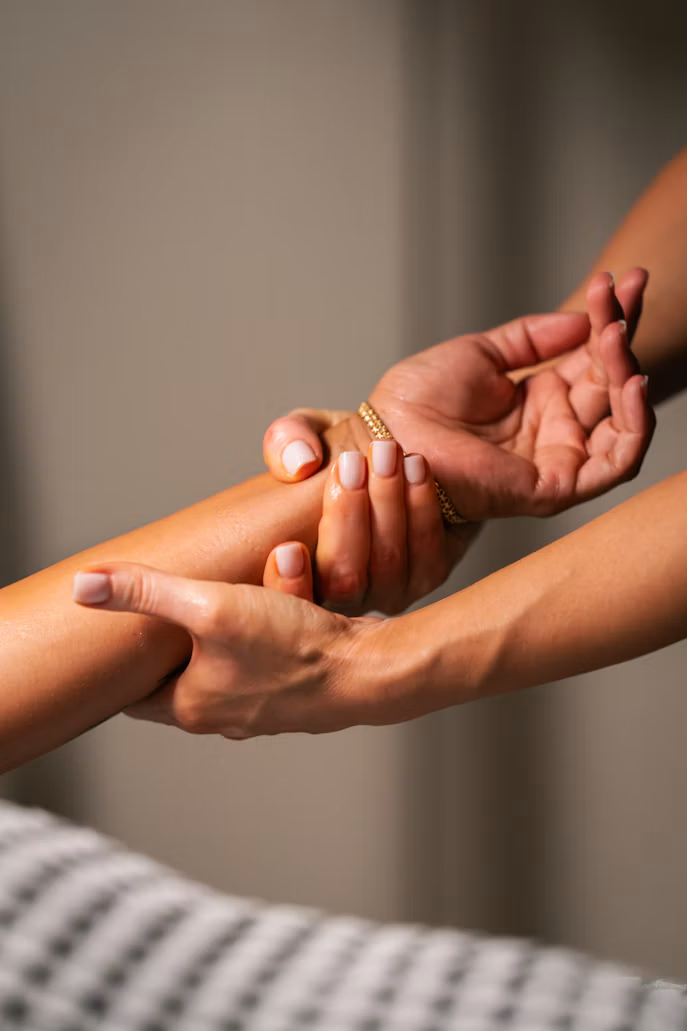
Massage can absolutely be a birthday treat or a Mother’s Day gift. But what if it’s also one of the more doable wellness habits you could add to your routine?
In Episode 4, Paris Cousins, a licensed massage therapist of 26 years, is joined by Stephanie Heidel of Foundation Mindset, a longtime client who wasn’t always a massage fan. Stephanie shares how she went from walking in with a painful kink in her neck to making massage part of her regular routine, and why she no longer sees it as selfish. Paris explains what’s happening behind the scenes: better circulation, relief for tight muscles and range of motion, and a boost in feel-good hormones like dopamine, serotonin, and oxytocin. They also talk about finding a therapist you connect with (a good one will welcome a free consultation first), how sessions can fit any schedule from weekly to once a year, and why even 30 minutes on your neck and shoulders can help if you spend your days at a desk or on your phone. Plus: how bodies tell stories, why some clients nap and others chat, and the fascinating science of fascia.
It’s a little time and a lot of benefit. They’re already talking about a part two.
Keep up with Oak Wellness
- Watch more episodes on the Acorns to Oak Wellness YouTube channel
- Visit Oak Wellness Center in Bartow, FL to learn about massage options
- Learn more about Stephanie’s classes and workshops at Foundation Mindset
Your turn
Thinking about your first massage, or getting back to one? Watch the episode, then reach out to Oak Wellness with any questions.
- Massage Therapy & Self-Care
- Paris Cousins: Hi everybody, we are back! It’s been a while since we’ve done an episode of the Acorns to Oak Wellness podcast, and I’m back with Stephanie Heidel, owner of Foundation Mindset. Today, we are going to talk about massage therapy. Now, I know just a little bit about massage therapy since I’ve been doing this for 26 years—I cannot believe it’s been 26 years that I’ve been a licensed massage therapist! Woohoo!
- Stephanie Heidel: An expert in the field, y’all!
- Paris Cousins: Well, experienced—we’ll just say experienced! [laughter] We are talking about how massage therapy is more than just a luxury. It can be a luxurious experience, and it can be an extra special thing that you do for yourself on a birthday, an anniversary, Mother’s Day, Father’s Day, or something like that. But I wanted to talk to Stephanie because she has been a long-time client and has made massage therapy a regular part of her wellness routine.
- Stephanie Heidel: Yes!
- Paris Cousins: So, I wanted to talk to you a little bit about that, and then you can ask me some questions, too. If you don’t mind, could you share a bit about how you began utilizing massage therapy as part of your wellness routine? Because originally, you weren’t someone who got massages.
- Stephanie Heidel: No, I was not a fan! To start, we’re always giving little tidbits of small things you can do for your wellness. This is a really great one to hold onto because you can say, “I’m doing this for my wellness.” In my opinion, it’s probably one of the easier wellness hacks to get behind because it doesn’t take the grit or discipline that other wellness tips sometimes require.
- Paris Cousins: Well, because it’s more about receiving than putting in physical effort.
- Stephanie Heidel: Yes! It’s still a financial commitment as part of your wellness journey, but I definitely think it’s about finding the value. That’s what I hope you’ll explain from the technical side—because I recognized the value just from receiving it. It’s kind of interesting because, since we’ve become so close, there have been times where I’ll discuss something with you afterward and you’ll say, “Oh yeah, that’s because I worked on blah blah blah.” And I’m like, “That’s so cool! There’s science behind this, and I just get to receive it!”
- In my personal journey, I did not actually care for massage therapy initially. As I’ve shared before—and as featured in The Bartonian—I was diagnosed with PTSD. Part of that was the reason I wasn’t able to enjoy massage therapy. As part of my recovery, I went through all kinds of intense, holistic therapies, and one of those modalities happened to be massage therapy.
- So, I knew the benefits back then. Fast forward: when I finished that program, I still didn’t make it part of my routine right away. I wasn’t there yet. But as we’ve talked about before—and as mentioned in the magazine—we first met because of a kink in my neck!
- Paris Cousins: Yeah.
- Stephanie Heidel: I came to Paris with the standard, “Oh my goodness, my neck! You’ve got to help me!” I was in real pain. Massage brought me out of pain, but then I realized that if I stayed on top of it, there were so many ongoing benefits. I’d love for you to share why that is, but I came to realize it’s about more than just waiting for a kink in your neck—it’s about making it a regular part of your routine.
- Paris Cousins: Right, right, because it really is! Before I get into the technical stuff, I want to back up just a little bit. Finding a licensed massage therapist that you connect with makes a huge difference, because being on a massage table can be a very vulnerable experience.
- Stephanie Heidel: Sure.
- Paris Cousins: For people who have a diagnosis like PTSD or trauma in their background, it can feel very vulnerable to open yourself up to being touched by someone you don’t know—a stranger. As a quick note: any licensed massage therapist should be open to a consultation before you schedule an appointment to get on the table if you have questions. That shouldn’t cost you any money. You should be able to meet with the therapist first to see if they’re the right fit for you, because not every therapist is the right fit for every person.
- That being said, the technical benefits of massage therapy include increasing your circulation, which delivers more nutrients to all the cells in your body. That happens even during a standard Swedish massage, which is a full-body relaxation experience. In your case, you came in with a specific issue, so we focused on that area rather than just general relaxation. It was more of a rehabilitation scenario.
- Stephanie Heidel: Yes, an “I’m injured and I need help” situation.
- Paris Cousins: Exactly. In that aspect, relaxing the muscles and improving blood flow, oxygen, and nutrients to the area reduces inflammation, increases your range of motion, and releases the tight muscles causing that kink in your neck.
- Overall, a full-body massage experience increases dopamine and serotonin, which are two of your feel-good hormones. It also increases oxytocin, which promotes connection and that sense of community we all need in a safe environment. On top of those hormonal benefits, circulation, and improved range of motion, it’s time for you as the client to decompress, take a moment for yourself, and pour back into your cup. As the article in The Bartonian said, you can’t pour from an empty cup. If you’re feeling depleted or at your wit’s end, it’s a great reason to slow down, rest, and receive those good intentions and physical benefits.
- Stephanie Heidel: What helps me not view it as selfish is remembering that filling your cup allows you to be there for others. That is so critical. When you take care of yourself, you simply have more to give.
- Paris Cousins: Yes.
- Stephanie Heidel: I truly don’t see it as selfish anymore, though it took a long time to get to that mindset. Now I realize, “No, this is important—it matters.”
- Paris Cousins: It really does. As we mentioned earlier, whether it’s 30, 60, or 90 minutes… or if you’re fortunate enough to do a two-hour massage, which we offer, it can fit into anyone’s lifestyle. A longer session is more of a time and financial commitment, but massage therapy can be customized for any routine. I see some clients weekly, some every two weeks, some monthly, some quarterly, and some just once a year. If once a year is all you can commit to, that’s great—it’s better than nothing!
- Making it part of your routine is like having a gym membership or buying healthy food; you budget for what’s important. Even a 30-minute session to focus on your neck and shoulders can make a world of difference. If you work at a computer or desk, dealing with “tech neck” and shoulders raised to your ears from looking at screens, releasing that tension helps your posture and allows you to breathe better. How many people do you see walking around hunched up like that without even realizing it?
- Stephanie Heidel: Right.
- Paris Cousins: A massage brings self-awareness back to your body. It helps with proprioception, which is your body’s awareness of where it is in space. We could do a whole deep dive into that!
- Stephanie Heidel: Even mindfulness! Mindfulness is such a buzzword right now that you hear everywhere, and people wonder what it actually means. But mindfulness can be as simple as paying attention to the exact moment you’re in right now. In a world full of distractions, that’s very difficult to do. During a massage, there’s a helpful thought of, “I paid for this hour, so I’m going to fully receive whatever my body needs right now.”
- I’d be curious to hear your perspective on this, because you work with so many different clients. I imagine some people use that time for quiet mindfulness, while others need the community aspect. You probably have clients who are chatty and others who are completely silent, and it’s neat that everyone can get what they need from that time—beyond just the safe, healthy physical touch. I want to emphasize that point: it is a safe, healthy touch.
- Paris Cousins: Yes! To be honest, the minute my hands touch some clients, they fall asleep and experience true rest. You can tell it’s a deep rest because their breathing instantly deepens and slows down into a state of total peace. I notice that a lot with my high-stress clients and executives. Then I have clients who love to chitchat. Some people live alone or don’t get much conversation throughout the day, so this is their time to have a one-on-one connection or chat about what’s going on in their lives. Sometimes I just listen, and sometimes we engage in conversation. I always take the client’s lead on whether they want to talk or be quiet, making sure their expectations for the session are met. So yes, sometimes it’s about community, and sometimes it’s simply about shutting off the mind to rest in silence.
- Stephanie Heidel: That’s so fascinating to me because our bodies tell a story. I’m curious about your thoughts on that, because you clearly have a gift for touch. It might sound funny, but do you feel like you can read people’s stories through touch? Not in a “woo-woo” way—
- Paris Cousins: No, not in a weird, “woo-woo” way! It can sound that way, but it’s entirely scientific. Our bodies emit energy. Everyone has experienced getting tingles on the back of their neck when something feels off—that’s energy and intuition.
- Bodies definitely tell stories. Sometimes clients forget to mention old injuries or past car accidents on their intake forms because it happened so long ago. But as a therapist, when you’re in tune with touch and have worked on as many bodies as I have over the years, you recognize distinct structural patterns. I remember a client at one of our retreats coming out and saying, “You must see with your hands.”
- Stephanie Heidel: Oh, I remember that!
- Paris Cousins: You remember that? That comment really stuck with me and resonated because I do “see” the tissue through touch. Different bodies tell different stories. Even if clients don’t tell me what they do for work, I can usually tell if they spend most of their time driving or sitting at a computer. Back when people used to cradle phone receivers between their ear and shoulder, I could immediately tell if someone answered phones for a living! People’s bodies hold the experiences they’ve been through. Some stories are great and some are sad, but as massage therapists, we’re trained to interpret those physical stories and provide a calm, safe environment for healing.
- Stephanie Heidel: That’s awesome. It can be a vulnerable experience, but vulnerability opens the door to great things—like healing.
- Paris Cousins: Absolutely. Vulnerability opens you up to healing in mind, body, and spirit. Allowing your story to be heard and held through safe touch is a blessing for the client and the practitioner. One of the best feelings is seeing a client walk out with a smile on their face, moving better and standing up straighter, knowing their needs were met during that session. You can see that their body received exactly what it needed, whether for physical pain or emotional relief.
- Stephanie Heidel: I’m always a little leery of things that sound too “woo-woo,” but like you said, there is so much real science behind what the body holds.
- Paris Cousins: Definitely. We don’t have to get super technical today—we can do that on another podcast—but you can examine all the layers of skin, muscle, fascia, connective tissue, and tendons. Connective tissue and fascia surround every single muscle fiber in the body. Beyond providing physical structure and posture support, science is discovering that fascia acts as an internal communication network. It fires the synapses that cause those tingles and physical intuitions. It’s a fascinating topic that I could total nerd out on!
- Stephanie Heidel: I love it! It’s so fascinating, and I think that’s why you’ve always been drawn back to massage therapy throughout your career. It’s 100% your gift. God created our bodies in such intricate ways that science is still only scratching the surface of how it all works. He put so much purpose into everything He created, and I know 1,000% that He created you for this purpose because you’ve been such a blessing in my life. When we were brainstorming podcast topics, I said, “My goodness, we have to talk about massage therapy!” Not only because of your technical expertise, but because of how powerful it is. My hope for this episode is that it helps at least one person realize that massage isn’t just a luxury—it’s a valuable part of self-care that you can fit into your schedule and budget.
- Paris Cousins: Definitely. Even a 30-minute massage focused on your neck and shoulders can offer world-of-difference relief. It’s a great introduction to the benefits of massage therapy. Thank you for the kind words—I truly feel that this is a gift from God, and I’m so grateful to share it with the community I grew up in.
- Stephanie Heidel: Well, this is one of our longer episodes, but I loved it and could keep talking about it! Maybe we’ll have to do a Part 2 down the road. Sound good?
- Paris Cousins: Yeah, let’s do it!
- Stephanie Heidel: All right, sounds great! Bye, guys!
- Paris Cousins: Bye, everyone!


Leave a comment